
HIP PM Material Application Cases | ISO 9001 Extrusion Spare Parts, Fast Global Shipping & Custom Machining - HO HSING
Browse HO HSING extruder parts: twin-screws & barrels, screen changers, gear pumps, machining parts. ISO 9001 OEM/ODM, fast delivery and global shipping.
HIP PM Material Application Cases
Breaking Processing Bottlenecks: Adopting Advanced European HIP PM Materials
In precision metal machining and extrusion molding, material selection directly governs component service life and production line stability. In addition to high-grade conventional mold steels (such as SKD61, SACM645, and DC53), Ho Hing Precision specializes in sourcing advanced HIP (Hot Isostatic Pressing) powder metallurgy alloys from Europe for extreme, highly demanding operational conditions.
The following case study objectively presents the physical characteristics of HIP materials in terms of wear resistance, corrosion resistance, and microstructural density, serving as an engineering reference for technical teams and procurement evaluation.
Production Bottlenecks & Operational Constraints
- Operational Conditions: The client’s production line processed specialized high-polymer formulations with high abrasiveness and corrosiveness (containing specific additives and composite compounds).
- Operational Bottleneck: The original discharge components, made from conventional alloy steels, experienced rapid wear around the orifice edges and flow channels under prolonged high shear stress and chemical degradation. This caused dimensional drift in the extruded melt and reduced product specification consistency.
- Operational Impact: Frequent shutdowns for disassembly and replacement not only increased labor hours and consumable costs, but also limited Overall Equipment Effectiveness (OEE), preventing the line from meeting design capacity targets.
Following an inspection of the worn components and operating parameters by the Ho Hing Precision technical team, it was determined that conventional ingot-cast steels—due to unavoidable carbide segregation and micro-porosities—readily develop localized micro-cracks and uneven abrasive wear under extreme operating conditions.
To resolve this issue, we recommended upgrading beyond conventional ingot-cast tool steels by adopting advanced European HIP powder metallurgy alloy materials:
European HIP Powder Metallurgy Technical Characteristics
- HIP Process Fundamentals: Utilizing an inert gas environment at elevated temperatures (typically above 1,000°C) and ultra-high pressures (often exceeding 1,000 bar), the metal powder undergoes 100% full densification bonding.
- Physical Advantages: Internal porosity and segregation defects are thoroughly eliminated, producing an ultrafine, isotropically distributed carbide structure that substantially improves resistance to both abrasive wear and high-stress micro-chipping.
To provide an objective baseline for material selection, our technical team summarized the key performance metrics of conventional steels, high-grade cold-work steels, and European HIP powder metallurgy alloys as follows:
| Evaluation Metric / Material Category | Conventional Tool Steels (e.g., SKD61 / SACM645) | High-Grade Cold-Work Steels (e.g., DC53 / K340) | European Advanced HIP Powder Metallurgy Steel |
|---|---|---|---|
| Microstructural Density | Standard (contains casting segregation & micro-porosities) | Good (secondary refined structure) | Superior (100% fully dense via HIP; defect-free) |
| Carbide Grain Distribution | Coarser grains with directional segregation | Medium grain size, relatively uniform | Extremely fine, highly isotropic & uniform distribution |
| Abrasive Wear Resistance | Baseline (1.0x) | Substantially improved (approx. 1.5x – 2.0x) | Exceptional (3x to 5x+ improvement) |
| Corrosion / Chemical Resistance | Relies on surface nitriding or electroplating protection | Moderate corrosion resistance | Outstanding (highly alloyed matrix providing deep corrosion resistance) |
| Chipping Resistance & Toughness | Standard (susceptible to micro-cracking at stress risers) | Good toughness | Superior toughness (full densification significantly reduces chipping risk) |
| Estimated Lifespan in Extreme Conditions | Baseline (100%) | Approx. 150% – 200% | Achievable 300% – 500%+ (subject to polymer formulations) |
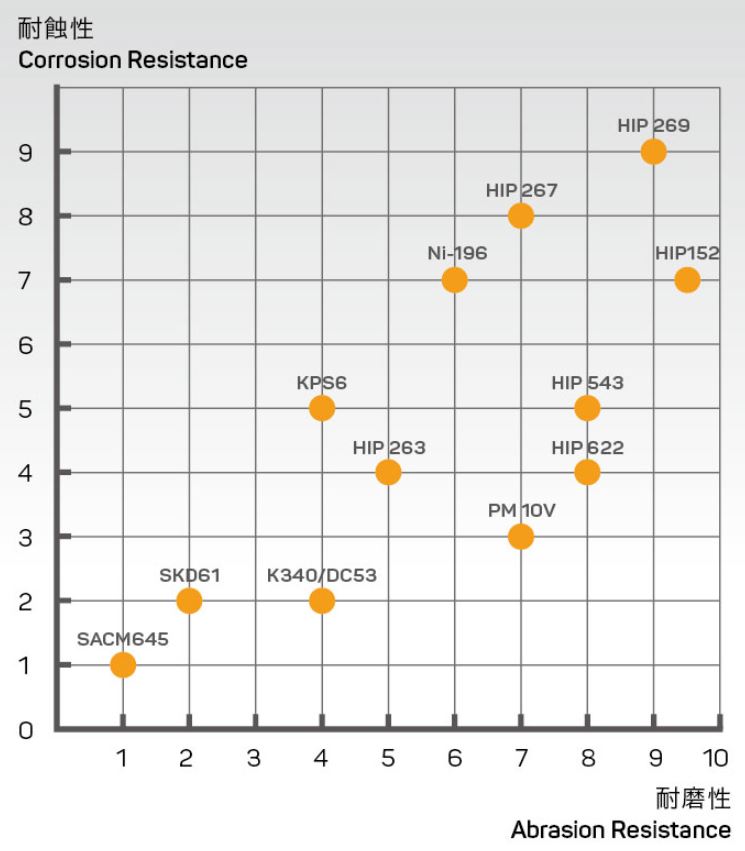
The chart above is for reference only. Actual wear and corrosion resistance may vary depending on specific operating conditions and applications.
Engineering Selection Note: For standard polymer processing, SKD61 or SACM645 paired with proper heat treatment offers sufficient cost-effectiveness. However, when processing resins with high glass-fiber loadings, abrasive fillers, or strong chemical acidity, European HIP powder alloys (such as HIP 263, HIP 543, HIP 622, HIP 267, HIP 269, or HIP 152) provide the most pronounced operational and commercial return in extending lifespan and preserving tight tolerances.
After commissioning components manufactured by Ho Hing Precision using European HIP alloy materials, the customer reported the following production metrics:
Ho Hing Precision maintains established European procurement channels and precision machining capabilities for advanced HIP powder metallurgy alloys. Clients may select this material option during inquiries or custom manufacturing requests:
Committed to Quality, Creating Value.
With 40+ years of experience, Ho Hsing has grown from OEM to a full-service company, guided by Japanese experts and driven by advanced technology.
Your Trusted Partner
We stand behind our products and are committed to resolving issues, ensuring full customer satisfaction.
Strict Quality Control
Our products undergo multiple checks during production to ensure accuracy and excellence in the finished results.
Professional Development Team
From OEM to a full company, we know the key components in industry and offer valuable advice to our customers.
Popular Products
Our flagship products are highly acclaimed for their stable quality and exceptional performance. Through our professional expertise and years of experience, we enable customers to effectively reduce part replacement time and costs, enhancing overall operational efficiency and value.
HIP PM Material Application Cases | Taiwan Twin-Screw & Twin-Barrel Manufacturer, Replacement Sets - HO HSING
With over 36 years of experience, HO HSING specializes in manufacturing twin-screws, twin-barrels, and double-pillar hydraulic screen changers. Guided by our commitment to excellence, we provide OEM-quality precision parts with full customization support. ISO 9001–certified and equipped with Mitutoyo CMM from Japan, we ensure zero-defect delivery and complete quality control to boost productivity and cut costs.
Choose HO HSING extruder parts—from twin-screw/twin-barrel replacements to hydraulic screen changer, gear pump, static mixer, die plate, and pelletizing head solutions. As a Taiwan OEM/ODM factory, we offer custom machining, fast lead times, and global shipping—request a quote to optimize plastic extrusion output and reduce downtime.
Since 1984, HO HSING has manufactured high-quality twin-screws, twin-barrels, and double-pillar hydraulic screen changers for plastic extrusion. Backed by advanced technology and 36 years of OEM/ODM experience, we deliver precision extruder parts, full customization, and rigorous quality control to meet demanding production requirements.